
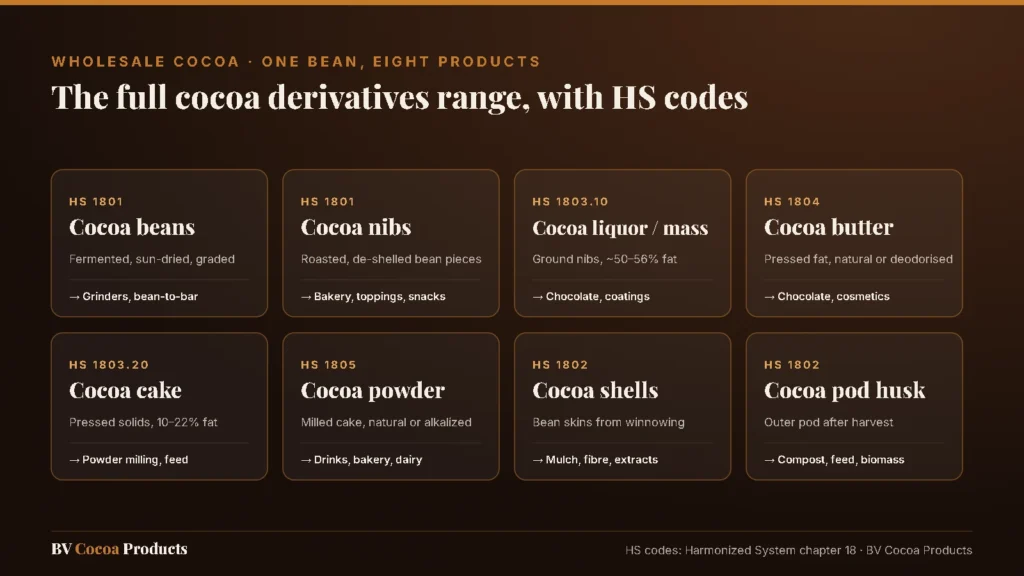
Cocoa butter manufacturers make cocoa butter by pressing roasted, ground cocoa beans (cocoa mass) to separate the fat. The result is a pale yellow fat that melts at about 34–36 °C, used in chocolate, cosmetics and pharmaceuticals. BV Cocoa Products supplies cocoa butter from Cameroon beans to manufacturers worldwide.
This guide walks through how cocoa butter is made, the grades and specifications buyers check, and how to choose a cocoa butter supplier.
Key takeaways
- Cocoa butter is pressed from cocoa mass, which is about 50–55% fat.
- Two main grades: natural (pure prime pressed) and deodorised.
- Free fatty acids (max 1.75%) are the key quality number.
- CBS and CBE are vegetable fats, not cocoa butter.
How cocoa butter is made
- Cleaning and roasting: fermented, dried beans are cleaned and roasted.
- Winnowing: shells are removed, leaving cocoa nibs.
- Grinding: nibs are ground into cocoa mass.
- Pressing: hydraulic presses squeeze the warm mass. Liquid cocoa butter flows out; cocoa cake stays behind.
- Filtering: the butter is filtered and, for deodorised grades, steam-treated to remove odour.
- Moulding and packing: it is cooled into blocks, usually packed in 25 kg lined cartons.
The full chain is explained in our guide to cocoa bean processing.
Cocoa butter grades
| Grade | What it is | Best for |
|---|---|---|
| Natural (pure prime pressed) | Pressed and filtered only; keeps cocoa aroma | Dark chocolate, premium confectionery, natural cosmetics |
| Deodorised | Steam-treated to remove smell and taste | White and milk chocolate, cosmetics, pharma |
Cocoa butter specifications buyers check
| Parameter | Typical target |
|---|---|
| Free fatty acids (as oleic) | Max 1.75% |
| Moisture and impurities | Max 0.2% |
| Melting point | About 34–36 °C |
| Colour | Pale to golden yellow |
| Peroxide value | Low; ask for the measured value |
High free fatty acids point to old or poorly handled beans and a softer, weaker-setting butter.
Cocoa butter vs substitutes
Cocoa butter substitutes (CBS) and equivalents (CBE) are vegetable fats made to copy cocoa butter. They are cheaper, but they change taste and melt, and in many markets products using them cannot be labelled “chocolate”. See our guide to cocoa butter substitutes.
How to choose a cocoa butter supplier
- COA for every batch: FFA, moisture, melting point and colour.
- Origin and traceability: to the bean region, plus EUDR evidence for EU buyers.
- Storage and transport: cocoa butter should travel cool and away from odours.
- Steady volume: pressing depends on bean supply, so ask how the supplier contracts beans.
Grades and packing are listed on our bulk cocoa butter page.
Request cocoa butter pricing
Tell us the grade, volume and destination. We send a COA, a sample and a quote.
Request a quoteinfo@bvcocoaproducts.comFrequently Asked Questions
Who are the biggest cocoa butter manufacturers?
Large grinders in Europe, Asia and West Africa make most of the world’s cocoa butter. Cameroon’s own grinders processed about 96,000 tonnes of beans in 2025/26.
How long does cocoa butter keep?
About 24 to 36 months in a cool, dry, odour-free store.
What is the difference between natural and deodorised cocoa butter?
Natural cocoa butter keeps its cocoa aroma; deodorised butter is steam-treated so it has almost no smell or taste.
Do you supply bulk cocoa butter?
Yes, in 25 kg cartons, by the pallet or container.