

Cocoa bean processing turns the seeds of the cocoa pod into the ingredients food makers buy: cocoa nibs, liquor, butter, cake and powder. It happens in two stages. First comes the initial processing on the farm, then industrial processing in a factory. This guide walks through each step and explains why it matters to buyers.
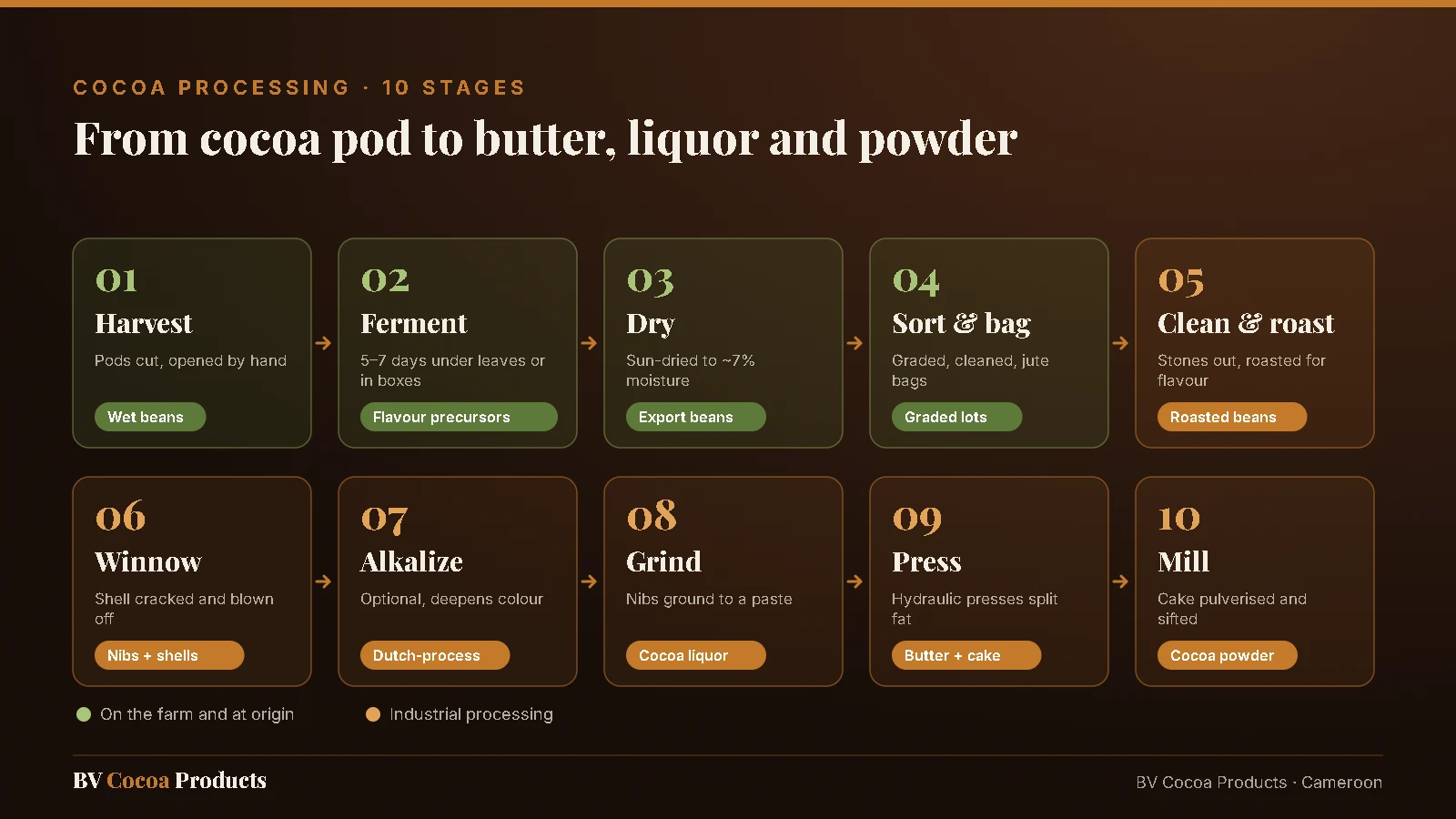
Cocoa processing is the 10-stage journey that turns cocoa pods into the ingredients industry buys. Farmers harvest, ferment, dry and sort the beans. Factories then roast and winnow them into nibs and shells, grind nibs into cocoa liquor, press the liquor into cocoa butter and cake, and mill the cake into cocoa powder.
Stage 1: Initial Processing of Cocoa Beans
Initial processing happens close to the farm. It decides much of the flavour and quality of the final product, so buyers pay close attention to it.
1. Harvesting and pod opening
Farmers cut ripe pods from the tree, then open them to remove the wet beans and their white pulp. The empty pod husks stay on the farm, where they usually return to the soil.
2. Fermentation
The wet beans are piled in heaps or placed in wooden boxes, covered and turned regularly for about five to seven days. During this time, the pulp ferments and the temperature rises. As a result, the bean’s germ dies and flavour precursors form. Poorly fermented beans taste bitter and astringent, so the cut test checks fermentation.
3. Drying
Next, the beans are dried, usually in the sun, until moisture falls to about 7–7.5%. Drying slowly and evenly prevents mould. In humid regions, some farmers also use artificial dryers. Poorly managed wood-fired dryers can give beans a smoky off-flavour, so good exporters check for it.
4. Sorting, grading and bagging
Finally, dried beans are cleaned, sorted and graded on moisture, bean count and the cut test. They are then packed in jute bags or loaded in bulk for export. Our guide on how to import cocoa beans from Cameroon covers this step in detail.
Stage 2: Industrial Cocoa Processing
In the factory, cocoa beans are turned into semi-finished products.
5. Cleaning and roasting
The beans are cleaned to remove stones, dust and other foreign matter. Then they are roasted, often at around 110–140 °C. Roasting develops the chocolate flavour and loosens the shell. Some processors roast the nibs instead of the whole beans.
6. Winnowing
The roasted beans are cracked, and air separates the light shell from the heavier nibs. The result is cocoa nibs plus cocoa shell, a useful by-product.
7. Alkalizing (optional)
For Dutch-process products, the nibs, liquor or cake are treated with an alkali. This darkens the colour and softens the flavour. It is how alkalized cocoa powder is made.
8. Grinding into cocoa liquor
The nibs are ground into a smooth paste. Because nibs are about half fat, the heat of grinding melts the cocoa butter and the paste becomes liquid. This is cocoa liquor. When it sets into blocks, it is sold as cocoa mass.
9. Pressing into cocoa butter and cocoa cake
Hydraulic presses squeeze the liquor. The fat flows out as cocoa butter, which is then filtered and often deodorized. The solid left behind is cocoa press cake, which still contains about 10–22% fat.
10. Milling cocoa cake into powder
The cake is broken up and milled into fine cocoa powder. Then the powder is cooled, sieved and packed, usually in 25 kg bags.
Cocoa Processing at a Glance
| Step | Output |
|---|---|
| Fermentation and drying | Dried cocoa beans |
| Roasting and winnowing | Cocoa nibs and cocoa shell |
| Grinding | Cocoa liquor, mass or paste |
| Pressing | Cocoa butter and cocoa cake |
| Milling | Cocoa powder |
Why Cocoa Bean Processing Matters to Buyers
Every step affects quality. For example, fermentation shapes flavour, drying affects mould risk, and pressing sets the fat content of cocoa powder. Therefore, buyers who understand the process ask better questions and write better specifications. For typical ranges, see our guide to cocoa specifications, SDS and COA.
Cocoa Processing in Cameroon
Cameroon is one of the world’s major cocoa producers, and it is also building its own grinding capacity. BV Cocoa Products buys beans directly from farmers and cooperatives and exports both beans and processed ingredients. Learn more about our cocoa processing and the full range of cocoa products we supply.
Talk to us about your cocoa needs →
Frequently Asked Questions
What are the main stages of cocoa processing?
Cocoa processing has two stages. Initial processing on the farm covers harvesting, fermentation, drying and sorting. Industrial processing covers cleaning, roasting, winnowing, optional alkalizing, grinding into cocoa liquor, pressing into butter and cake, and milling into powder.
How long are cocoa beans fermented?
Cocoa beans are usually fermented for about five to seven days, in heaps under banana leaves or in wooden boxes, before they are dried.
What products come from cocoa processing?
Cocoa processing produces cocoa nibs, cocoa shells, cocoa liquor (also called cocoa mass or paste), cocoa butter, cocoa cake and cocoa powder. The pod husk is a by-product of harvesting.
Ready to buy? See our cocoa processing capabilities, the wholesale cocoa products guide, or request a quote.