
Industrial cocoa powder is cocoa powder bought by food factories in 25 kg bags or bulk, against a fixed specification and a supply contract. Manufacturers choose the grade by application, lock fat, pH, colour and micro limits into the contract, and test every lot on arrival.
This guide is for buyers in bakery, dairy, beverage and confectionery plants who need consistent cocoa powder at scale.
Key takeaways
- Match the grade to the line: natural for soda-leavened bakery, alkalized for drinks and dairy.
- Write fat, pH, colour, fineness and micro limits into the contract.
- Test every arriving lot against the approved sample.
- Buy from origin, from a distributor, or both, depending on volume.
Matching cocoa powder to your production line
| Application | Typical grade | Why |
|---|---|---|
| Cakes, brownies (baking soda) | Natural, pH 5.0–5.8 | Acidity reacts with soda |
| Biscuits, cookies | Red or dark alkalized | Colour and rounder taste |
| Chocolate milk, RTD drinks | Light alkalized, 10–12% fat | Disperses well, less sediment |
| Ice cream | Light or red alkalized, 20–22% fat | Creamy flavour |
| Compound coatings | Low-fat alkalized | Works with vegetable fats |
| Sandwich cookies | Black alkalized | Near-black colour without additives |
What goes into a supply contract
- Specification: fat %, pH range, moisture, fineness, colour values, taste.
- Micro limits: total plate count, yeast and mould, Enterobacteriaceae, Salmonella absent in 25 g.
- Contaminants: cadmium and lead limits for your market.
- Volume and call-off: annual volume with monthly or quarterly shipments.
- Price: fixed for a period, or linked to the cocoa market.
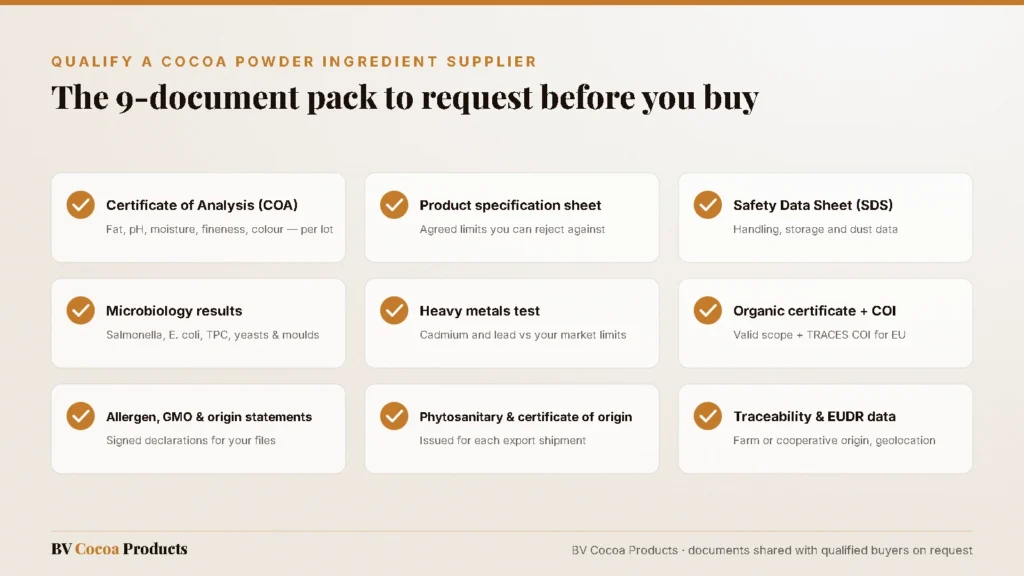
- Documents: COA per lot, certificate of origin, allergen statement. See typical SDS and COA specs.
QA checks when a lot arrives
- Check the COA against the contract spec.
- Test pH and fat in your own lab.
- Compare colour with the retained approved sample.
- Run a small production trial before releasing the lot.
Origin supplier or cocoa powder distributor?
Large plants often buy containers direct from origin and keep a local cocoa powder distributor for top-ups. Smaller plants usually buy pallets from distributors. Compare both routes in cocoa distributors vs direct exporters, and see every grade on our bulk cocoa powder page.
Set up an industrial cocoa powder contract
Send your spec and annual volume. We return a matching grade, samples and contract terms.
Request a quoteinfo@bvcocoaproducts.comFrequently Asked Questions
What is industrial cocoa powder?
Cocoa powder sold to food factories in bulk against a fixed specification, rather than retail-packed cocoa.
How is industrial cocoa powder packed?
Usually in 25 kg multi-wall paper bags with a PE liner, on pallets.
How often should I test incoming cocoa powder?
Check every lot’s COA and test at least pH, fat and colour in-house before use.
Do distributors sell industrial cocoa powder?
Yes, by the pallet. For container volumes, buying at origin is usually cheaper.