

A reliable cocoa supplier delivers the same quality lot after lot, with clear documents, transparent pricing and enough volume to keep your production running. To choose one, check eight things: traceability, lab data, food safety, export documents, capacity, pricing, logistics and service.
Whether you buy cocoa beans, cocoa powder or cocoa butter, your cocoa supplier shapes your costs, your product quality and your compliance. This guide gives you a practical checklist, compares the main types of cocoa supplier and lists the questions to ask before you sign a contract.
Key takeaways
- Judge a cocoa supplier on eight points, not on price alone.
- Container buyers usually get the best price and traceability from an exporter at origin.
- Always test a new supplier with a sample, a lab check and a trial lot.
- Prices should be linked to a public benchmark, such as the ONCC reference price or the ICCO daily price.
What does a cocoa supplier do?
A cocoa supplier sells cocoa beans or cocoa products to manufacturers, importers or distributors. Some buy beans from farmers and cooperatives and export them. Others process beans into cocoa liquor, cocoa butter and cocoa powder. Still others resell cocoa that they bought from someone else. Therefore, the first question is simple: where does your supplier sit in the chain?
The 8-point cocoa supplier checklist
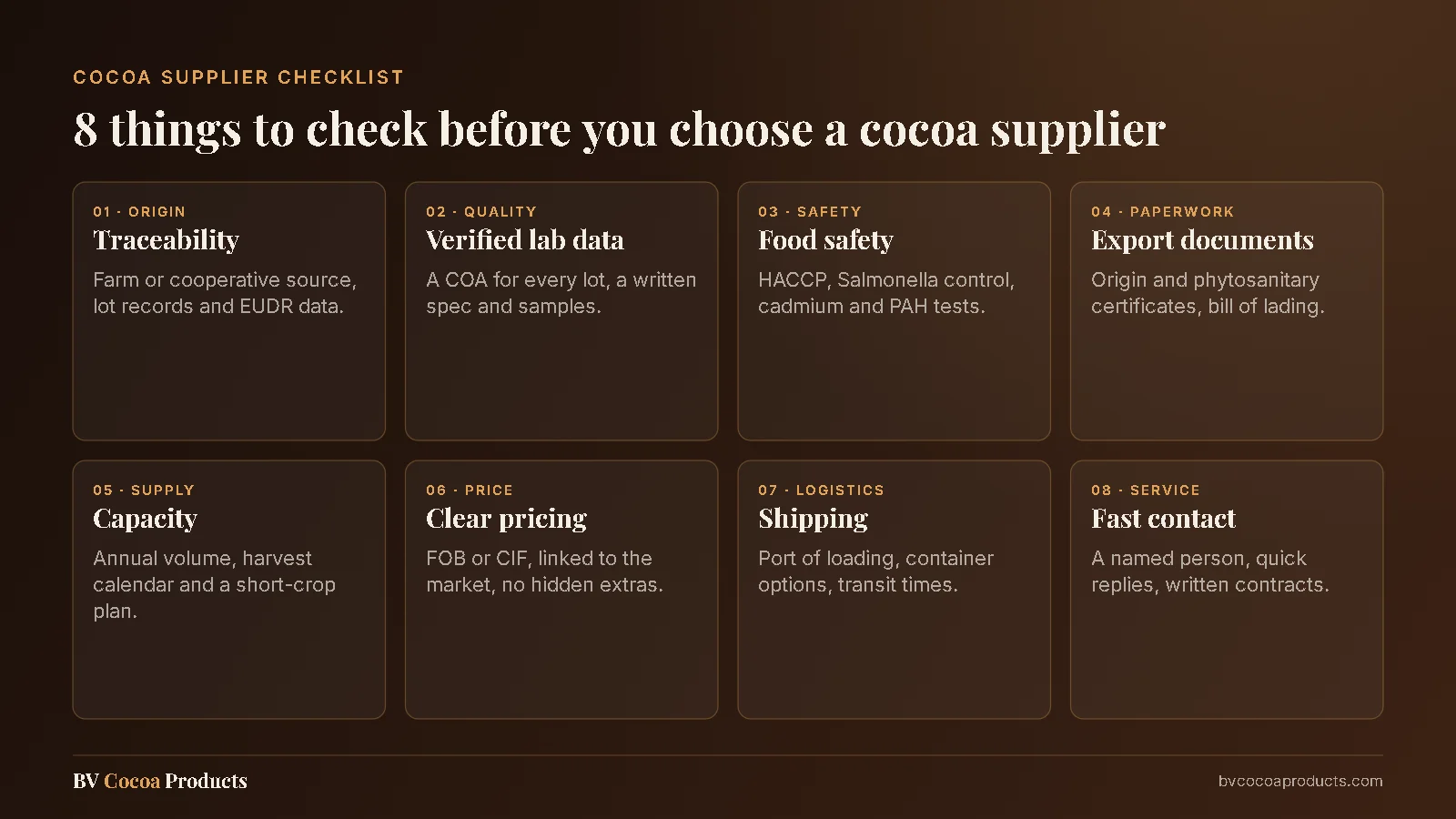
- Traceability. Ask where the beans come from: which region, which cooperatives, which lots. EU buyers also need geolocation and due-diligence data under the EU Deforestation Regulation.
- Verified lab data. A serious supplier sends a written specification and a Certificate of Analysis (COA) for every lot, plus pre-shipment samples on request.
- Food safety. Check how the supplier controls Salmonella, moisture and foreign matter, and whether it can share test results for cadmium, PAHs and pesticide residues.
- Export documents. The supplier should handle the certificate of origin, phytosanitary certificate, bill of lading, invoice and packing list without delays.
- Capacity and continuity. Compare your annual volume with what the supplier can ship, and ask how it plans for short crops and the off-season.
- Clear pricing. Prices should state the Incoterm (FOB or CIF) and how they relate to the market, with no hidden extras for bags, inspection or documents.
- Shipping and lead times. Confirm the port of loading, container sizes, booking times and realistic transit times to your port.
- Responsive contact. You need a named person who answers quickly, sends written offers and signs clear contracts.
Types of cocoa supplier compared
Not every cocoa supplier works the same way. As a result, the right choice depends on your volume, how much traceability you need and how quickly you need the goods.
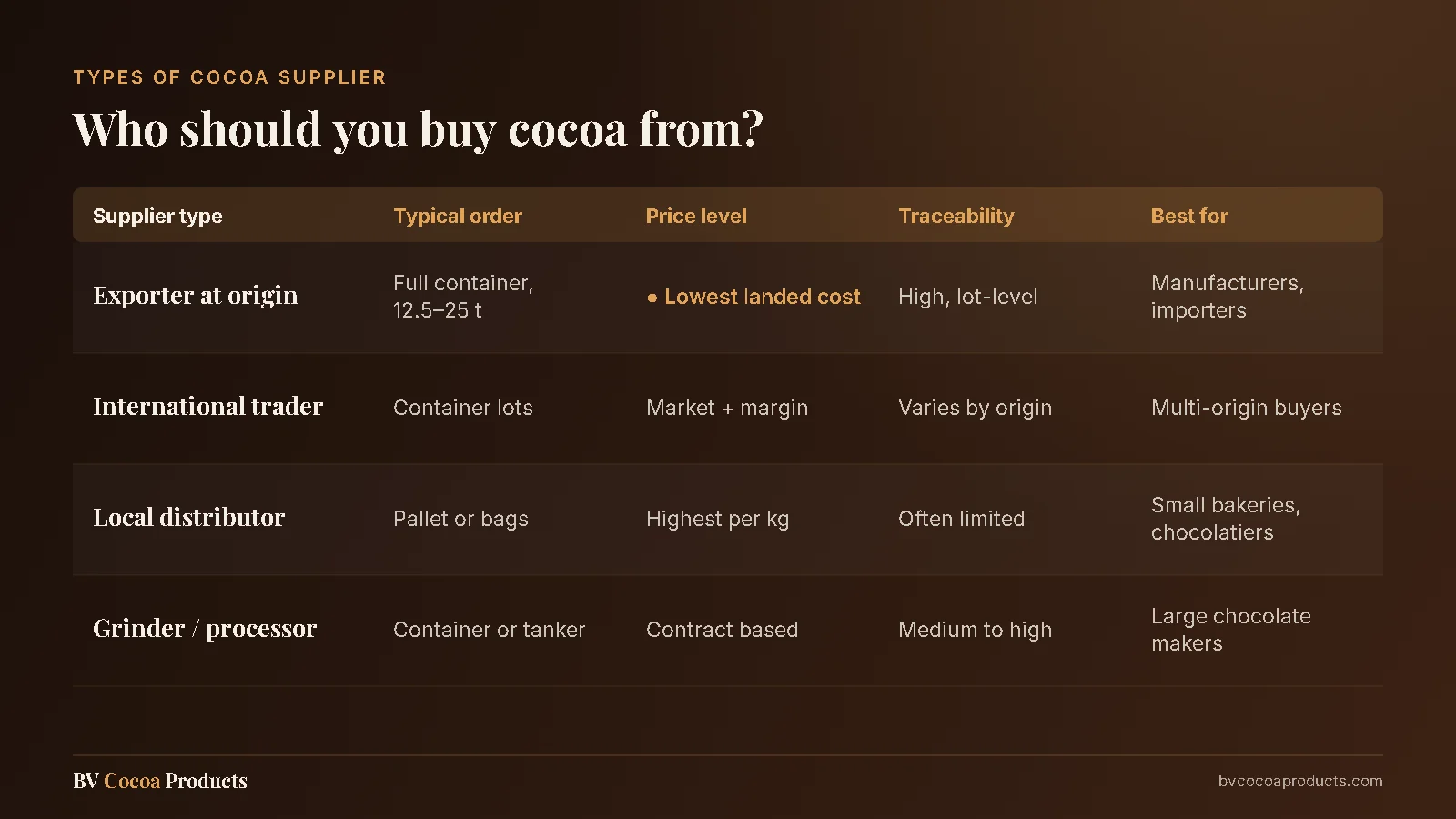
| Supplier type | Typical order | Price level | Traceability | Best for |
|---|---|---|---|---|
| Exporter at origin | Full container (about 12.5–25 t) | Lowest landed cost | High, lot-level | Manufacturers and importers |
| International trader | Container lots | Market price plus trader margin | Varies with origin mix | Buyers who need several origins |
| Local distributor | Pallet or single bags | Highest per kg | Often limited | Small bakeries and chocolatiers |
| Grinder or processor | Container or tanker | Contract based | Medium to high | Large chocolate makers |
For a deeper comparison of local stockists and origin exporters, read cocoa distributors vs direct exporters.
Questions to ask a cocoa supplier before you order
- Which regions and cooperatives do your beans come from, and can you prove it?
- Can you send a specification sheet and a recent COA for the product I need?
- How do you control moisture, mould and Salmonella?
- Which contaminant tests do you run, and how often?
- How much can you ship per month, and what happens in a short crop?
- Is your price FOB or CIF, and how is it linked to the market?
- Which port do you ship from, and how long does booking take?
- Who is my contact person, and what payment terms do you accept?
Red flags to watch for
- Prices far below the market with no explanation.
- No samples, no COA or vague answers about origin.
- Pressure to pay a large deposit before any documents are shared.
- Claims that cannot be checked, such as certifications without certificate numbers.
How to test a new cocoa supplier
- Approve a sample and test it in your own lab or with a third party.
- Start with a trial lot, ideally one container, before a long contract.
- Use independent inspection at loading to confirm weight, quality and packaging.
- Agree secure payment terms, such as a letter of credit or cash against documents.
- Review the first shipment against the contract before you scale up.
Why buyers choose a cocoa supplier in Cameroon
Cameroon is one of the world’s major cocoa origins. According to ONCC, the country produced 247,914 tonnes of cocoa in the 2025/26 season. In addition, ONCC publishes daily reference prices, so buyers can check offers against an official benchmark. See the Cameroon cocoa price today.
BV Cocoa Products is a Cameroonian-owned cocoa supplier and part of BV Holdings PLC. We buy directly from farmers and cooperatives and export cocoa beans, cocoa powder, cocoa butter, cocoa liquor and other cocoa products, with a COA and full export documents on every shipment.
Looking for a cocoa supplier you can rely on?
Tell us the product, volume and destination port. We will send specifications, samples and a quote based on today’s market.
Request a quoteView our productsFrequently Asked Questions
What makes a good cocoa supplier?
A good cocoa supplier delivers consistent quality backed by a Certificate of Analysis for every lot, full export documents, traceable origin, transparent pricing linked to the market, and enough volume to supply you through the season.
Should I buy from a cocoa exporter or a distributor?
If you buy full containers, a direct cocoa exporter at origin usually gives the lowest landed cost and the best traceability. If you need small, frequent deliveries, a local distributor is more practical.
What documents should a cocoa supplier provide?
Expect a commercial invoice, packing list, bill of lading, certificate of origin, phytosanitary certificate, Certificate of Analysis and, for the EU, traceability data for the EU Deforestation Regulation.
How do I test a new cocoa supplier?
Approve a pre-shipment sample, test it in your own or a third-party lab, start with a trial lot, and use independent inspection at loading before moving to a longer contract.
Sources: ONCC; International Cocoa Organization. Photos: cocoa beans drying, Chuck Moravec, CC BY 2.0 (cropped, text added); cocoa pods, CIRAD, CC BY 3.0; both via Wikimedia Commons.