

The key vendor criteria for sourcing bulk cocoa liquor for a multinational confectionery brand are consistent quality against a written spec, a GFSI-recognised food safety system, traceable and EUDR-ready origin data, secure supply capacity, human-rights and sustainability due diligence, clear pricing and price-risk terms, reliable logistics, and complete documents for every lot.
Cocoa liquor is the heart of chocolate. A large brand may run dozens of lines on the same liquor, so one weak supplier can stop a factory. This checklist turns the eight criteria into questions your procurement, quality and sustainability teams can score.
Key takeaways
- Score suppliers on 8 weighted criteria. Quality, food safety, traceability and supply security usually carry most of the weight.
- EUDR applies to large operators from 30 December 2026. Origin geolocation is now a buying requirement, not a nice-to-have.
- Typical liquor spec: fat 50–56%, moisture ≤ 2%, fineness ≥ 99% through 75 µm.
- Price risk is real: New York cocoa rose about 49% between 1 June and 13 October 2026.
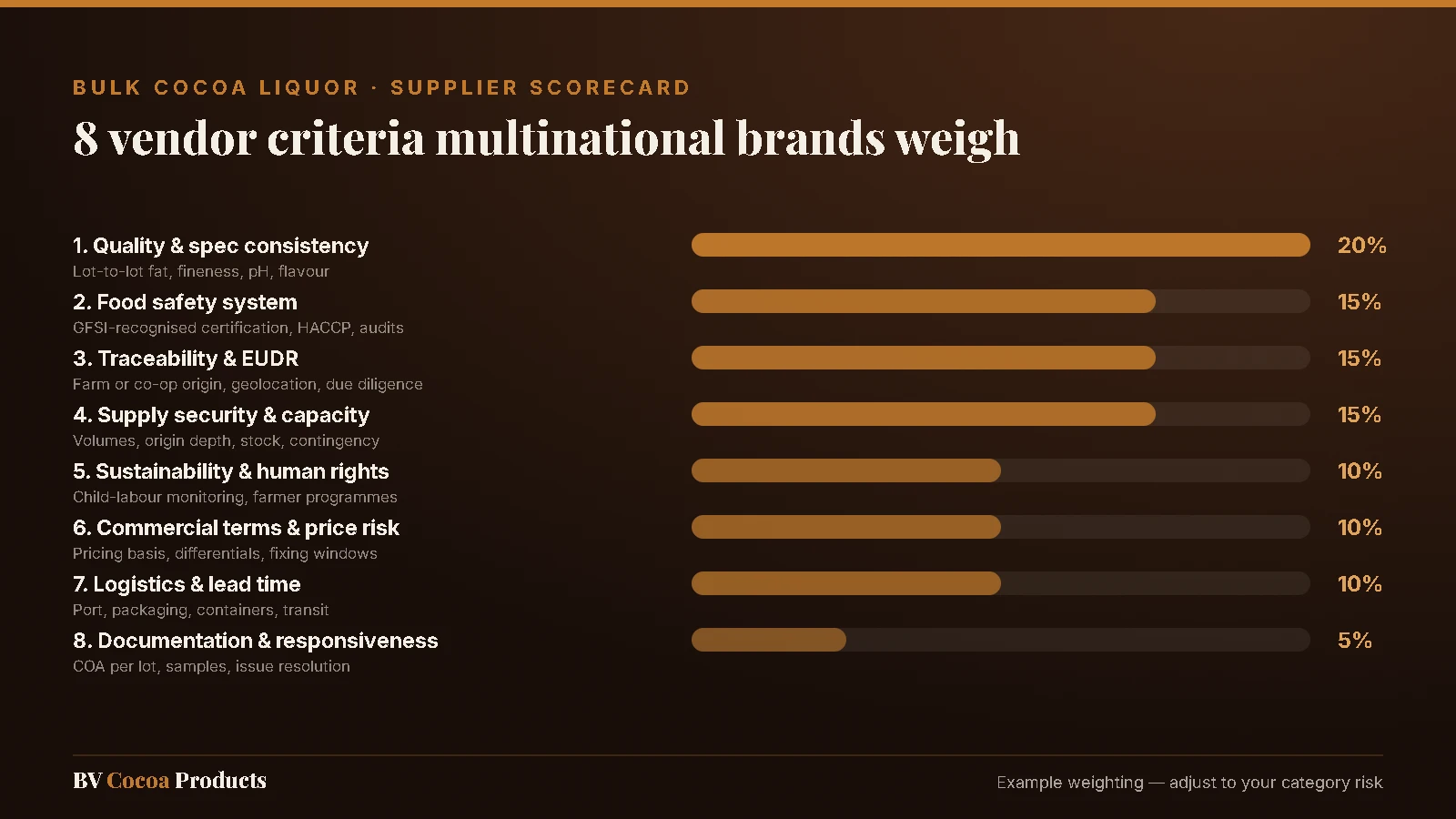
What are the key vendor criteria for sourcing bulk cocoa liquor for a multinational confectionery brand?
1. Quality and specification consistency
The liquor must hit the same fat, moisture, fineness, pH and flavour profile lot after lot. Your chocolate recipe, viscosity and tempering all depend on it.
Ask the supplier:
- Your written specification and a recent COA for three consecutive lots
- How the taste profile is controlled against a reference sample
- How out-of-spec lots are detected, held and reported
2. Food safety system
Multinationals expect a food safety system recognised by GFSI, such as FSSC 22000, BRCGS, IFS or SQF, built on HACCP. Foreign-matter control and microbiology matter most for liquor.
Ask the supplier:
- Current certificate, scope and last audit result
- Sieving, magnets and metal detection on the line
- Salmonella testing plan and sample size per lot
3. Traceability and EUDR readiness
The EU Deforestation Regulation applies to large operators from 30 December 2026 and to smaller ones from 30 June 2027. Cocoa placed on the EU market must be deforestation-free and traceable to the plot of land.
Ask the supplier:
- Can each lot be traced to farms or cooperatives?
- Do you hold geolocation data for the plots?
- What data will you hand over for our due diligence statement?
4. Supply security and capacity
Cocoa supply is fragile. Cameroon’s marketed crop fell about 20% in 2025/26, and Côte d’Ivoire’s 2026/27 output is forecast below baseline. A supplier with deep sourcing networks keeps your line running.
Ask the supplier:
- Annual volume you can commit to us
- How many cooperatives and regions you buy from
- Your plan if one origin or region falls short
5. Sustainability and human rights
Brands now report on child labour, farmer income and forests. Your supplier’s programmes become part of your own reporting.
Ask the supplier:
- How child labour risk is monitored and remediated
- What farmers receive and how you work with cooperatives
- Evidence behind any sustainability claim
6. Commercial terms and price risk
Cocoa is volatile. New York futures moved from $3,899 per tonne on 1 June 2026 to $5,805 on 13 October 2026. Agree how price is set before you agree volume.
Ask the supplier:
- Pricing basis: fixed price, or futures plus a differential
- Fixing windows and how unfixed volume is handled
- Incoterms, payment terms and currency
7. Logistics and lead time
Liquor ships as solid blocks in lined cartons or as liquid in heated tankers, depending on the route. Port access, packaging and transit time all affect your stock levels.
Ask the supplier:
- Port of loading, transit time and container options
- Packaging format, pallet pattern and shelf life
- Who handles delays and how fast you are told
8. Documentation and responsiveness
The best suppliers send the right papers without being chased. That saves your quality team hours on every shipment.
Ask the supplier:
- COA per lot, spec sheet and SDS
- Certificate of origin, packing list and bill of lading
- Named contacts for quality, logistics and contracts
Cocoa liquor specifications for confectionery production
Cocoa liquor specifications for confectionery production cover fat, moisture, fineness, acidity, shell content, microbiology and taste. These are the numbers to write into the contract, so every delivery can be checked against them.
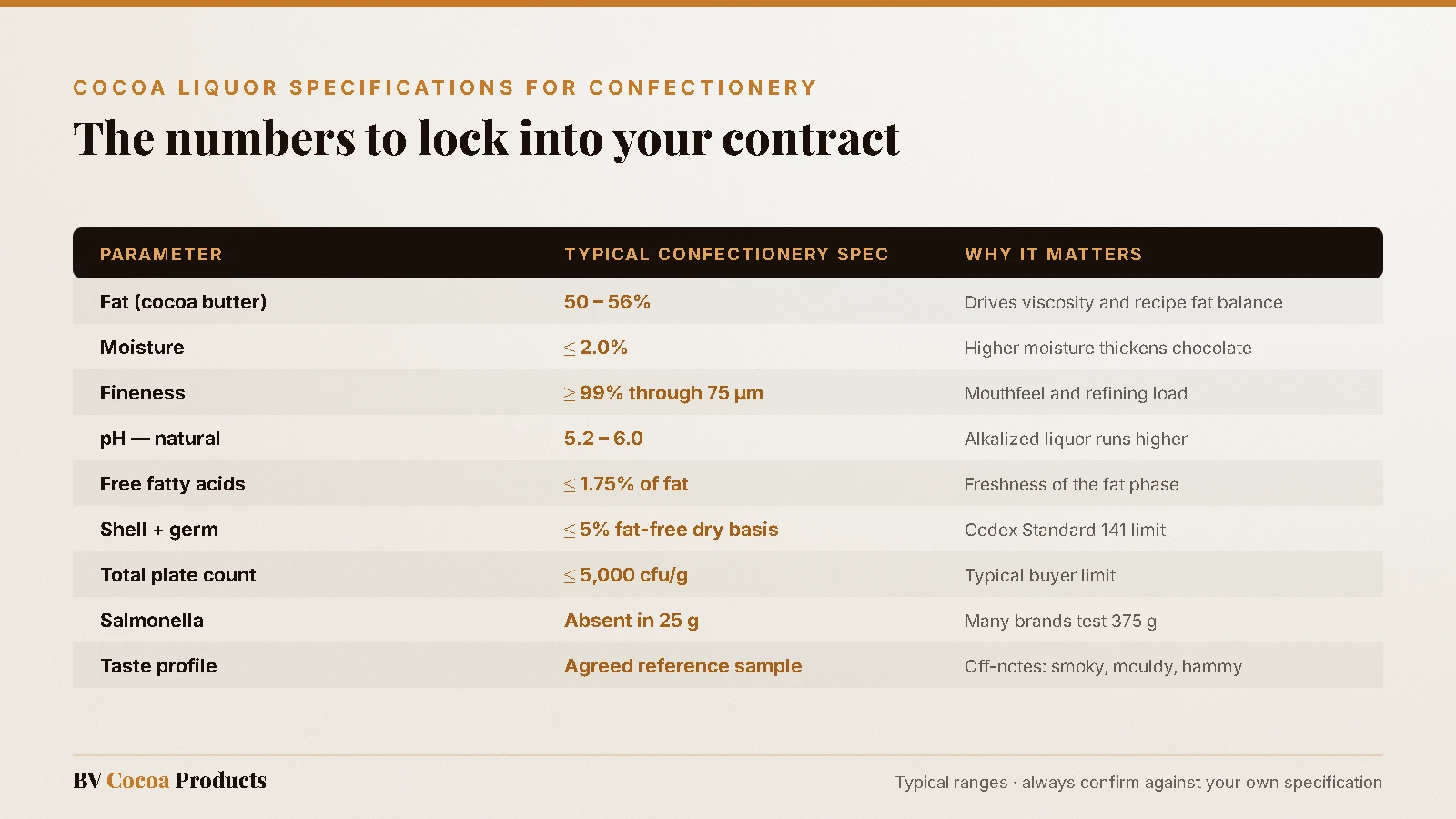
Fat drives viscosity and the recipe fat balance. Moisture above about 2% thickens chocolate during conching. Shell and germ content is limited by the Codex standard for cocoa mass to no more than 5% on a fat-free dry basis. For the full breakdown, read our cocoa liquor specifications guide and cocoa mass vs cocoa liquor vs cocoa paste.

How to qualify a new cocoa liquor supplier in six steps
- Send a request for information. Use the eight criteria above as your questionnaire.
- Test samples. Run fat, moisture, fineness, pH, FFA and micro in your own lab, plus a taste panel.
- Audit the site. Review the food safety certificate, then audit on site or remotely.
- Run a trial lot. Put one container through your factory and track performance.
- Approve and contract. Lock the spec, pricing basis, volumes and documents into the contract.
- Review every quarter. Score delivery, quality and responsiveness, and share the score with the supplier.
Sourcing cocoa liquor from Cameroon with BV Cocoa Products
BV Cocoa Products is a Cameroonian-owned cocoa exporter that buys directly from farmers and farmer cooperatives. That direct link is what makes traceability possible, and it is why buyers come to us when they need origin data, not just a price.
We supply cocoa liquor, cocoa mass and cocoa paste, together with cocoa butter and cocoa powder. Serious buyers can request our technical documents and our Cameroon government-backing documentation as part of supplier qualification.
Start your supplier qualification
Send us your liquor specification and annual volume. We reply with a matching COA, documents and a quote.
Request a quoteinfo@bvcocoaproducts.comFrequently Asked Questions
What are the key vendor criteria for sourcing bulk cocoa liquor?
Eight criteria: quality and spec consistency, a GFSI-recognised food safety system, traceability and EUDR readiness, supply security, sustainability and human rights, commercial terms and price risk, logistics, and documentation.
What fat content should cocoa liquor have for confectionery?
Most confectionery buyers specify cocoa liquor with 50–56% fat, alongside moisture of 2% or less and fineness of at least 99% through 75 microns.
When does EUDR apply to cocoa liquor imports?
The EU Deforestation Regulation applies to large operators from 30 December 2026 and to smaller operators from 30 June 2027. Cocoa liquor is in scope, so suppliers must provide traceability and geolocation data.
What food safety certification should a cocoa liquor supplier have?
Multinational brands usually require a GFSI-recognised scheme such as FSSC 22000, BRCGS, IFS or SQF, built on HACCP, plus a Salmonella testing plan for every lot.
How is bulk cocoa liquor priced?
Usually as a fixed price or as cocoa futures plus a differential for origin and quality. The ICCO conversion factor of 1.25 tonnes of beans per tonne of liquor helps compare liquor prices with bean prices.