

An organic cocoa powder supplier sells cocoa powder made from certified organic cocoa beans and ships it under a valid organic certificate, such as EU Regulation 2018/848 or the USDA National Organic Program. A cocoa powder ingredient supplier delivers natural or alkalized powder to food manufacturers against an agreed specification, with a certificate of analysis for every lot.
Your powder decides the colour of a brownie, the taste of a chocolate drink and whether a clean-label claim holds up in an audit. This guide shows what food brands should ask an organic or conventional cocoa powder supplier, which specs belong in the contract, and which documents to collect before the first container ships.
Key takeaways
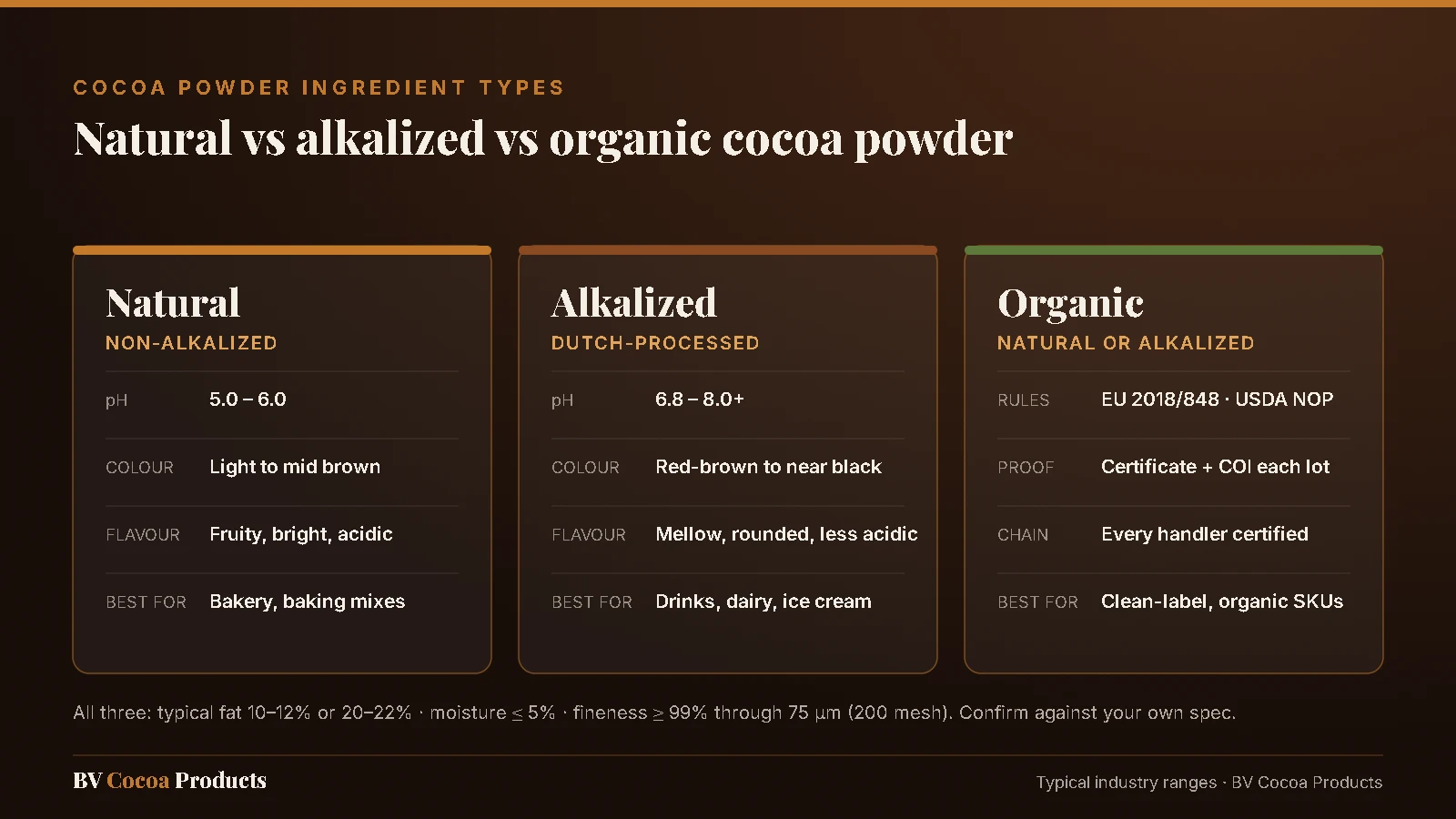
- Choose the powder type by application: natural (pH 5.0–6.0) for bakery, alkalized (pH 6.8–8.0+) for drinks and dairy.
- Typical specs: fat 10–12% or 20–22%, moisture ≤ 5%, fineness ≥ 99% through 75 µm.
- Organic is a chain, not a label. Every handler must be certified, and EU imports need a COI in TRACES per shipment.
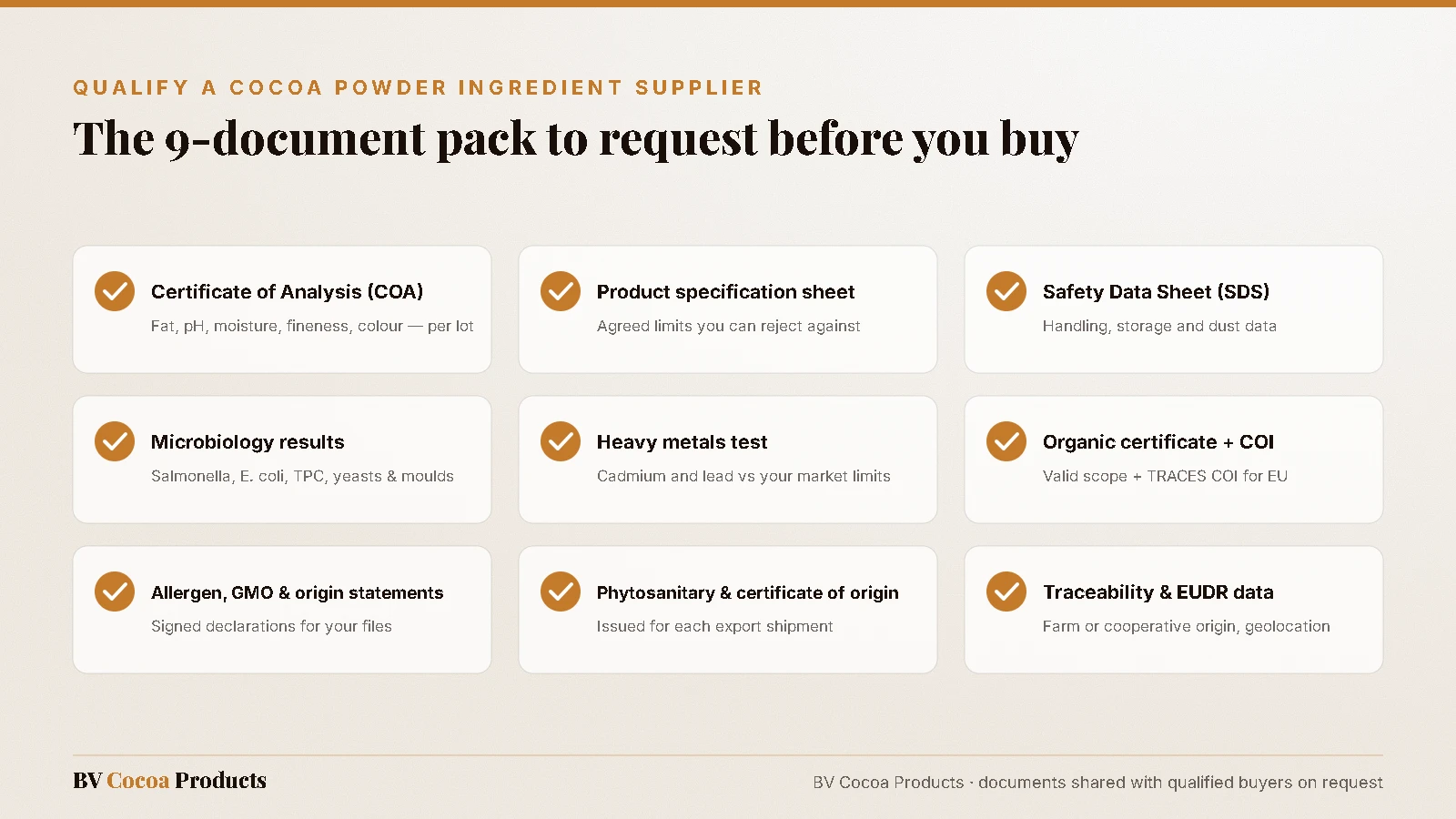
- Ask for a COA, spec sheet, SDS, micro and heavy-metal results for every lot.
Cocoa powder ingredient supplier: what food manufacturers need
A cocoa powder ingredient supplier is judged on one thing above all: does every bag behave like the last one? Picture an R&D manager at a biscuit plant. The new batch of dark cookies comes out grey instead of deep brown. Nobody changed the recipe. The supplier changed its alkalizing level without saying so. A week of production is now on hold.
That is why serious buyers lock in the powder type, fat level, pH and colour for each application, then hold the supplier to it.
| Application | Typical powder | Typical fat | Why |
|---|---|---|---|
| Bakery, cakes, biscuits | Natural or lightly alkalized | 10–12% | Natural powder reacts with baking soda for lift |
| Chocolate drinks, beverage mixes | Alkalized | 10–12% | Mellow taste, darker colour, better dispersion |
| Dairy, ice cream, desserts | Alkalized | 10–12% or 20–22% | Richer colour; higher fat for a fuller taste |
| Coatings, fillings, compounds | Natural or alkalized | 10–12% | Colour and flavour matched to the brand |
| Supplements, clean-label snacks | Natural, often organic | 10–12% | Minimal processing and simple labels |
Organic cocoa powder supplier: how certification really works
An organic cocoa powder supplier must prove the whole chain is certified. That means the farms or farmer groups, the processor that roasts, presses and mills the powder, and the exporter that sells it. If one link is missing, the powder cannot be sold as organic.
What to check
- The certificate scope. It must name the supplier and list cocoa powder, not only cocoa beans.
- Validity dates. An expired certificate means the lot is conventional.
- Shipment paperwork. For the EU, each organic consignment needs a Certificate of Inspection (COI) in the TRACES system. For the US, the Strengthening Organic Enforcement rule requires an NOP Import Certificate.
- Mass balance. Ask how organic and conventional lots are kept apart at the factory and the warehouse.
A supplier who answers these four points quickly, with documents, is a supplier who has done it before.
Cocoa powder specifications to put in your contract
| Parameter | Typical range | Notes |
|---|---|---|
| Fat content | 10–12% or 20–22% | Low-fat for drinks and baking, high-fat for richer taste |
| pH | 5.0–6.0 natural · 6.8–8.0+ alkalized | Sets colour and flavour |
| Moisture | ≤ 5% | Higher moisture risks caking |
| Fineness | ≥ 99% through 75 µm (200 mesh) | Smooth mouthfeel, no grit |
| Colour | Agreed reference sample | Light brown to near black |
| Microbiology | Salmonella absent; E. coli absent; TPC and yeasts & moulds to your limits | Test every lot |
| Cadmium | Below your market limit | EU limit for cocoa powder sold to consumers: 0.60 mg/kg |
Need the full technical sheet? See our cocoa powder SDS, MSDS and COA guide and the technical documents library.
Natural, alkalized or organic: which should you buy?
Start with the product, not the price. If your recipe uses baking soda, natural powder gives you lift and a bright cocoa flavour. If you make a chocolate drink, an alkalized powder dissolves better and tastes smoother. Organic sits on top of either choice. It is a certification, not a flavour, so you can buy organic natural or organic alkalized powder.
Price follows the same logic. Alkalized and high-fat powders cost more to make. Organic adds a premium for certified beans and segregated processing. For a deeper comparison, read our bulk cocoa powder supplier guide.
Why source cocoa powder at origin in Cameroon
Buying closer to the farm gives you more control. In the 2025/26 season, Cameroon delivered 95,946 tonnes of cocoa to local processors, according to ONCC, and the country ranks among the world’s top exporters of cocoa products. Sourcing at origin shortens the chain between the bean and your powder.
BV Cocoa Products is a Cameroonian-owned exporter that works directly with farmers and farmer cooperatives. We supply cocoa powder alongside cocoa cake, cocoa butter and cocoa liquor, so one supplier can cover your whole cocoa ingredient list. Looking for organic lots? Ask us about current availability and we will send the certificate documents with the quote.
Request a cocoa powder sample and spec sheet
Tell us your application, fat level, pH range and volume. We send matching specifications, a COA and a quote.
Request a quoteinfo@bvcocoaproducts.comFrequently Asked Questions
What does a cocoa powder ingredient supplier provide?
A cocoa powder ingredient supplier provides natural or alkalized cocoa powder to food manufacturers against an agreed specification, plus a certificate of analysis for each lot, a spec sheet, a safety data sheet and test results for microbiology and heavy metals.
Is organic cocoa powder natural or alkalized?
It can be either. Organic is a certification of how the beans were grown and handled, so you can buy organic natural cocoa powder or organic alkalized cocoa powder.
What documents prove cocoa powder is organic?
A valid organic certificate that names the supplier and lists cocoa powder, plus shipment paperwork: a Certificate of Inspection in TRACES for EU imports, or an NOP Import Certificate for the United States.
What fat content should cocoa powder have?
Most cocoa powder is sold at 10–12% fat for baking and beverages, or 20–22% fat for a richer taste in dairy and desserts.
What is the EU cadmium limit for cocoa powder?
Regulation (EU) 2023/915 sets a maximum of 0.60 mg/kg of cadmium for cocoa powder sold to the final consumer, including sweetened cocoa powder and drinking chocolate.